Monday, October 24, 2011

Proceeding to Palolem

September 25th, 2011

One afternoon while sitting at a beach restaurant table with Naomi, two Israelis that Naomi shared a taxi with from the Dabolim airport (Goa’s only airport) to Arambol wandered by. After a short discussion, the option to join Iftach and Iren, a recently married couple, in a taxi to head to Palolem Beach about 80 kilometres away presented itself. Why not, it would save us 1000 rupees and they seemed like a very friendly couple. So today was the day we would head south.

Iftach and Iren hired the taxi from their guesthouse and the driver was a young fellow by the name of James. As most young men are, James was a speedy driver and coupled with the fact that it was Sunday afternoon we made great time transiting from one end of Goa to the other (in relative Indian travel terms). Like most other Indian drivers, James believes that the horn is an integral tool in driving a vehicle. He had honked at least a dozen times in our first kilometre of travel. Ironically, the one time when I thought he should have used the horn, when we were a mere foot from hitting the tail of a motorbike...he didn’t!

It was a hot day out and we began the trip with all windows rolled down and I was lucky to be in the comfort of the front seat (being the old man of the group) and we all agreed that it was time for air conditioning. It was then that James informed us that it would be 400 rupees extra ($9) for A/C....what!?! C’mon, I know it consumes more gas but not that much! We didn’t spring for the extra luxury to begin with but the outside temperature climbed by 5 degrees up to 34 C by the time we passed the Goan capital Panjim and we then opted to stave off the heat and agreed to the extra charge.

The terrain changed as we neared Palolem. It became hillier yet extremely lush with green vegetation. The road serpentined up and down with many ramshackle shelters housing vegetable sellers situated at many of the curves. We turned into the paved yet narrow road into Palolem Beach road. Being a backpacker, you can’t help but feeling like “fresh meat”. Showing up with your luggage and the look of disorientation on your face makes you an instant magnet for locals badgering you to stay at their guesthouse or beach huts.

We dismissed the first couple of pushers and walked down towards the beach hoping to first get the lay of the land however we did agree to check out one guesthouse that this older man with a bicycle wanted to show us. But first....WOW! What a gorgeous beach!

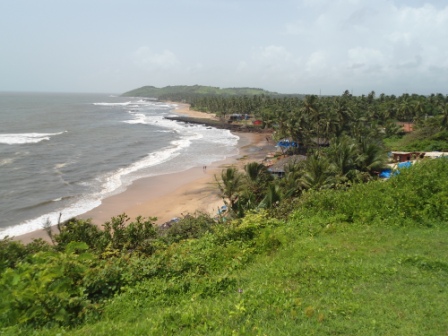
It’s a sandy, sheltered, crescent shaped, palm tree lined cove of utter beauty. At the north end a small, tidally influenced river spills into the sheltered bay. At all but high tide it is easy to walk to the end of the beach where a narrow gap in the land allows glimpses of the rocky headlands that remind me of some shorelines back home in British Columbia.

Now back to the accommodation search... The inn was set back from the beach about 100 meters and the ladies thought that was too far so we continued our search. After about an hour of reconnaissance (performed mostly by Naomi and Iren), we ended up returning to the original place.

Our view from Fernandez:
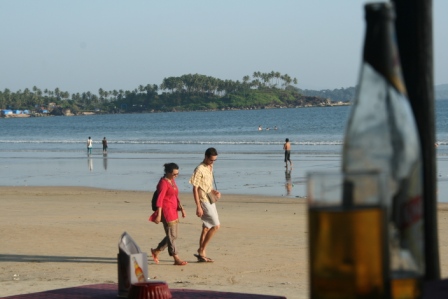
A couple of old men walking by:

In Fernandez:

After hanging out in a chilled restaurant on the beach called Fernandez, Naomi and I explored part of the north side of the beach. We were approached by a local fellow sporting green rimmed sunglasses who mentioned a one hour boat ride up a river that we could do for just 150 rupees ($3) per person. He walked with us as we approached the small river whose level was rising with the tide. A boat, his boat, was just pulling in and the two tourist occupants disembarked. He couldn’t have asked for better advertising as the dark fellow that could have been of Jamaican descent raved of the tour. An SLR camera with a lens about the length of my forearm hung from his neck. I joked with Naomi that she must have camera envy as hers, still very impressive, was about 6 inches shorter in length. After some photography shop talk, we parted ways having booked our excursion for 9am the next day with the sunglasses fellow on his 15 foot, basic wooden boat, the River Princess.

What I think of Palolem:

Okay, maybe Naomi doesn't get the concept of the jumping photo shot...a bit too close no?


This is more like it:

Naomi and I then sat down on the sand and I attempted my first meditation session. Naomi leads a group at work in weekly meditations so why not take advantage of her services as a teacher/guide. We sat facing each other on a sarong that we spread on the sand as she began to explain the concepts, procedures and goals of our meditation. I was impressed with her guiding ability and I committed myself to giving it my best effort at my first foray towards “zen-ness”. I focussed mainly on the lapping of small waves at the mouth of the creek but there was a myriad of sounds to choose from ranging from various chirping birds, bigger waves rolling in and of course some human activity. Being just after sunset, we both could have done with some insect repellent and that was the main detractor to my ability to truly dive into the realm of removing all conscious thought from my mind. I felt it was a good first attempt though so thanks Naomi!

Another gorgeous sunset:

That evening we joined Iftach and Iren for a meal at an Italian restaurant called Magic Italy. The ambience was nice, much more upscale than anything in Arambol but I was quite disappointed with my pizza and the service was pretty tragic...at least the company was fun and some good giggles were had! Iren was the only one who enjoyed her meal so I don’t think this place will see a second sighting of us. Oh well, sometimes you win...sometimes you lose...

Sunday, October 23, 2011

Namaste Naomi

September 22nd, 2011

Back in February I met an Israeli woman, Naomi, through another Israeli friend, Zohar, who returned to Arambol after being south in the state of Tamil Nadu for a month. It was Naomi’s second time to India but first time in Goa. We hit it off well and have stayed in contact since via email and Skype. She works in Human Resources for the global software company SAP in Tel Aviv while simultaneously studying “body psychotherapy” in a five year course...busy lady! She decided to return to India for a month long holiday, starting in Goa and heading south to the state of Kerala for the middle couple of weeks.

After a red eye flight to Mumbai and an hour long hop to Goa, Naomi arrived mid afternoon to a sunny, hot day. It seemed that she’d brought the weather with her as the previous week was still on and off with the rain but now perhaps the monsoon season had finished. I’m sure that’s wishful thinking on my part but I did enjoy seeing bright blue skies with hardly a cloud in the sky. I’d actually just asked Derek the Chilli’s Guesthouse owner the day before when the cloudless days would start and I quickly got my answer. Naomi on the other hand wasn’t that happy with the weather as she was hoping for a brief reprieve from the Israeli summer heat. She hasn’t seen rain since February.

Naomi's taxi arrives:

As luck would have it, on the first night that she arrived, I began to feel a mild fever take hold during the night. The following day I wasn’t too ill and we did walk around the cliff on the north end of Arambol to the Sweet Water Lake but that was about it. The second night I woke up a few times, completely drenched in sweat as my body fought to break the fever. It worked and although my stomach still wasn’t 100% I knew that the worst was over. Now I could be a proper host (yes, I’ve been in India long enough that I think I can use that term...at least for the north part of Goa and most definitely for Arambol!). However, the plan was to check out some new places so soon we would head to the south end of Goa, to a beach renowned for its natural beauty called Palolem.

Oh, side funny note...on the first night we ate at a restaurant called “Blue Mangoes”. It’s common in India to find funny typos or mistranslated words in the menus that can end up being a bit funny to a native English speaker. Well at this place, we had sat at one of these “chill out” tables that sit about a foot off of the ground with pillows all around. Well at the back of the menu it said it was a “Multi Cushion Restaurant”! I think that they really meant a multi-cuisine but hey, they technically were correct...and it did provide a good giggle for us.

The "Multi-Cushioned" Restaurant:

Monday, September 19, 2011

Lunch with the “Itas”

September 9th, 2011

I had to head into the small city of Mapsa to get an issue with my Internet connection sorted out. It’s about 45 minutes on the scooter and I thought I’d take advantage of having rented a bike so I decided to head to Anjuna beach for lunch. I have been to Anjuna 3-4 times before and wrote about the market they have there during the tourist season. In case you missed it, Anjuna used to sport the reputation of being the “freak capital of the world” in the 90s with lots of recreational drugs, many trance parties and people trying to combine the spiritual traditions of the east with the west’s hippie art and music.

Looking down at Anjuna beach:

Today however, it was a very quiet beach with the sun shining down on the relatively calm sea. I explored some of the back roads on the scooter before stopping at the south end of the beach. There’s a small knoll defining the border of the beach and I’ve seen guys paragliding there before but not close up. Today a man was just setting up so I watched him take off and fly around for a bit. It looked nice but it is a pretty small hill, smaller than Arambol.

The solo paraglider in flight:

As I walked along the beach, looking for a restaurant for lunch, I passed three young women picking up sticks and placing them into their white canvas bags. I figured that they were just gathering firewood for cooking at home. The youngest of the three said hi to me as I walked by which I reciprocated with a “Namaste”. She then proceeded with the common “Where are you from?” question. We chatted for a few minutes and I learned that she was 13 years old and her name was Anita. Her friends were 16 year old Lalita and 17 year old Sunnita...no wonder they’re friends!

As I began to wander off continuing my search for a lunch spot, Anita called out and started to walk towards me. She asked whether I would buy a drink for them as they were working hard in the hot sun and were parched. There was something about her style and technique and even her boldness that I had to admire and for a small amount of money (to me), why not help these young women out? There wasn’t an obvious place to buy refreshments right there so instead I offered her 100 rupees (a little over $2) for her to buy some soft drinks and she’d even have a little change left over.

My three new friends:

Seeing that I was in a good mood, Anita upped her ante and asked whether I could buy some chicken noodles that they could share. They weren’t actually collecting the sticks for their homes but would be taking them to Mapsa to sell for a minimal amount of money considering the effort. Okay, how could I refuse? Anita, the sly girl, then raised the stakes again and requested 3 chicken noodles. I think it was the fact that she was looking out for her friends that I caved on that request too.

The restaurant was just around to corner and sadly they aren’t allowed to go there. So I told them I would return within the hour with their food and drinks. I sat at a table by the sea and ordered a sandwich along with the three chicken noodles (to go) and three Cokes. I ate my sandwich and then headed back down the beach to find the three girls sitting patiently with big smiles on their faces.

We sat together in the sand as they opened up the containers. I was asked a couple of times by Anita and Lalita if I wanted some noodles but I declined. Regardless, Anita scooped some noodles onto one of the lids of the containers and passed it to me. “It is better if we all eat together” she said. I thought that was pretty cool and wise for a 13 year old. She has a good head on her shoulders but sadly she’s no longer in school as her family can’t afford it.

Me with Lalita on the left and Sunnita on the right:

Anita take a self shot:

Anita snapped one of me:

We chatted about a variety of topics and I thoroughly enjoyed their company. As they finished their food, Anita warned me of some lamanis (beach sellers of jewellery, sarongs etc.) approaching. I was the only “gorah” (foreigner) on the beach, so the only target. It didn’t really matter to me, I had but 30 rupees left in my wallet and buying jewellery and sarongs is pretty low on my to do list. The girls were off to catch a bus into Mapsa to sell their wood while I hopped back on my scooter to head back to Arambol.

The "Itas":

Thanks for a pleasant afternoon Anita, Lalita & Sunnita!

Friday, September 16, 2011

Ganesh Chaturthi


September 5th, 2011

Every year there is a Hindu festival held in celebration of the god Ganesh. The date varies from year to year as it starts on the fourth day of the waxing moon period and lasts for ten days. In the previous months, many clay models of Ganesh are sculpted and many homes proudly display them in their living rooms with it surrounded by colourful lights and flowers during the celebration time. At the end of the festival, the idols are paraded through the streets accompanied by dancing and singing followers and then it is tossed into a river or the sea. It symbolizes Ganesh journeying off to his home in Kailash while taking the misfortunes of his devotees with him.

There are many deities in Hinduism but Ganesh is up there in importance. He’s easily recognizable as he sports an elephant head. He is the son of two other big league gods, Shiva and Parvati. Shiva, meaning the “auspicious one”, is known as the destroyer god or transformer while Parvati is the supreme Divine Mother...sounds like some interesting parents! One story as to how Ganesh got his pachyderm cranium is that he was born with a human head but then Shiva beheaded him (“Thanks Dad!”) for getting between Shiva and Parvati and replaced it with an elephant one so that he wouldn’t be so alluring. Interesting family...

This year September 5th was the day when Ganesh would go swimming. On Arambol Beach, local families and friends began gather together on the beach in front of a small table with their Ganesh idols in the early evening. I wandered down there with an English gentleman, another Dave, who has been around Arambol for the past few months.

The idols were set up in a neat row, all facing away from the sea and back towards the temple. Some were lit up by old school camping torches while others had electric light powered by large batteries that were carried in. They varied in size slightly and Dave mentioned that the higher caste, wealthier families of the local community would have the larger statues. People sat down in front of the icons, lighting incense, sparklers while others walked the length of the display, sprinkling flower petals over the Ganeshes.

The Ganesh line-up:

Looking down the line:


Kids lighting incense and sparklers:

As we walked up and down the line inspecting the idols, I kept a wary eye on the various amateur fireworks being lit behind us at a rather close distance. A couple of times a malfunctioning bottle rocket would fly indiscriminately towards the crowd...I did shield my eyes on more than one occasion. I enjoyed the Roman candles spurting into the air and there was an impressive firecracker run that lasted a couple of minutes which surely didn’t do any favours to any one’s eardrums.

Fireworks:

The fireworks:


Singing broke out with a circle of men and boys chanting away as a couple of them beat on bongos. Dave and I waited around a while, hoping the procession of the Ganesh idols into the sea would soon happen but my empty stomach was letting itself be known. Dave told me that there would be people of lower castes charged with walking the statues out into the ocean but with the tide being way out and no moon present there wasn’t going to be much to see so we opted to head back to the regular monsoon season restaurant, 21 Coconuts, for dinner.

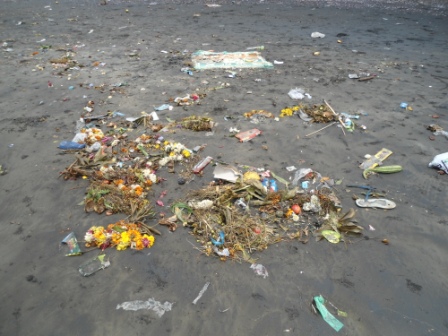
The next day I walked down to that same area on the beach, unfortunately knowing what to expect but I wanted to see it myself...what a clutter of trash! Incense boxes, fireworks debris, trampled flower garlands...yikes. I guess religion can be messy...

The ensuing mess:


Happy Ganesh Chaturthi!

Tuesday, September 13, 2011

Monsoons Mundane?

August 31st, 2011


Although I am experiencing a monsoon season for the first time, I knew to expect some inclement weather (d’uh) so there were going to be days of hanging around in my room escaping the precipitation. Thankfully I was able to acquire 70-80 movies from some fellow travellers but one cannot watch films all the time. I have been reading a lot, more than any other time in my life, which is a good thing. I read an 1100 page Tom Clancy novel followed by Gregory David Robert’s 950 page Shantaram (which I recommend) in a span of about a month and a half (lightning speed for me!).

I did recently stumble along in one book though. It’s considered one of the top 100 books of all time so when I found it in one of the “Internet cafes/Xerox centre/book store” places, I snapped it up. The book was “Catch 22”, a tale of World War II bomber pilots who were stuck in a predicament where if they went on bombing missions they were likely to be shot down and die. To avoid flying missions, if they proved they were insane then they would be sidelined for medical reasons. However, you’d have to be crazy to go on such risky flights so the fact that they were pretending to be crazy to avoid the deadly missions in fact proved that they were sane...a Catch 22.

Well I ran into my own Catch 22. I have been swapping books with the manager of one restaurant, Sporting Heroes. It turns out that Madu had already attempted the book, this very copy that he had traded in before I bought it, and he said he got half way and gave up. I ran into the same problem. I didn’t find the book that interesting enough to finish it but since it is in the “Top 100 Books of All Time”, I wanted to finish it...however, I eventually surrendered and . Ironically I then switched to a book that Madu gave me, appropriately titled “Cut and Run”!

Totally unrelated...just A funny sight one day...the lifeguards must have been having lunch:

Reading aside, I wanted to have a few activities that felt productive in some way (not that reading isn’t kids!) and came up with a few solutions.

The first was to try and pick up how to play a guitar. I had no visions of becoming a rock star as musical dreams have previously been removed from the equation thanks to my experience of playing trumpet for 6 years in high school. Now don’t get me wrong, I don’t think I was too bad of a player, in fact I shared First Trumpet position in my last few years but it was only thanks to brute force, repetitive practice. I was overshadowed and humbled by a fellow classmate, who was admitted to the school based on his flair with the horn and whose father was the conductor of the Edmonton Symphony Orchestra! He ripped through the “Flight of the Bumblebee” in a chapel service in front of the whole school and I knew I’d never reach that kind of level.

But over the years I have a number of friends who play guitar, ranging from capable to lead a campfire song to playing in bands or solo for money. My ultimate goal would be the former.

While I was in England last year I stayed with my cousin Sid and his now fiancée Sonia. Sid, being a member of the “can lead a campfire song” group, gave Sonia and I some lessons with her strumming the new guitar he gave her for her birthday. We learned a few chords and attempted to string a few of them together in a sad attempt at Oasis’ Wonderwall. Perhaps Blunderwall would be a more appropriate title. We both also learned the resulting pain in building up calluses on the fingertips. But just a few weeks after we began, I flew off to India.

So one day back in July I scootered into the small city of Mapsa and after asking for directions from at least four separate individuals, I finally located the music store. I explained my situation to the young salesman and he pulled down a used Rolf acoustic guitar and handed it to me. Not recalling much from Sid’s lessons, I asked him to strum it a bit for me. He stated that he didn’t play but he knew some chords and the guitar sounded just fine to this newbee. Costing about $50, I bought the Rolf and decided to also invest in a digital tuner over the cheap, blow a C note type whistle. I figured I needed all the help I could get!

My axe:

I downloaded some guitar lessons from the Internet and have started working my way through them. Of course I had to repeat the callus building process but that didn’t take too long. So far I haven’t progressed terribly far and I’m just working on connecting open chords together but it’s been a fun, almost daily, activity.

If only I knew how to play it:

I’m a firm believer that when travelling in a foreign country that it’s important to learn a few basic phrases such as “Hello”, “Thank you” and even “How are you?” and “What’s your name?”...oh, and the crucial “Can I have another beer please?” Since I’ve been in India for many months, it’s time to step that up a notch.

India is a country of many, many languages, with 35 recognized regional languages. But if any language could be considered the national language, it would be Hindi (and English is a close second). I’ve seen figures stating that there are around 150-300 million Hindi speakers in the world, 4th or 5th (depending on your source) after Mandarin, English and Spanish.

I had bought a Hindi book back in March but had hardly touched it. The first half dozen pages introduced the alphabet, which is called Devanagari script, in an overly confusing manner. There are individual characters for the 11 vowels and 30+ consonants however there is some “joining” of letters that is sometimes done.

Consonants inherently have an “a” sound (as in “alert”) so the symbol for the letter “k” is “क”and is pronounced “ka”. However the book did not clearly explain that you only use the vowels when they sit alone or start a word. Otherwise, there’s a way to join them to a consonant character in order to change the way the consonant is pronounced. For instance, if I want to say “ko”, the letter “o” is “ओ” but you take the “ka” symbol (“क”) and change it to “को” (adding that vertical line after it with an accent at the top). Clear as mud? I thought so. To get a handle of the 40+ character alphabet, I made some little flashcards. Writing these symbols took a little work but I have to admit that it was kinda fun learning a new alphabet.

Some of my Hindi tools:


My Hindi homework:

One last parting note: my favourite Hindi word so far is the word for “milk”. In Devanagari it is written as “दूध”. Phonetically it is “doodh”, with emphasis on the “oo”...pronounced just like in the movie the Big Lebowski!

One of my better "waiter/Hindi teacher" Sanjay:


नमस्ते! (Namaste!)

Thursday, September 1, 2011

Fort Corjuem

August 12th, 2011

There were a few items that I needed to pick up in Mapsa, the 50,000 population city about 30 kilometres south from Arambol. One item was a guitar string...yes, I’m learning to play guitar but more on that in the next blog entry.

After my errands, I looked at a map in the Lonely Planet guide for Goa (which I have thanks to my Dutch friend Marian leaving behind for me back in January) and decided to do some scooter exploration to the east of Mapsa. There is an island created by a couple of rivers called Corjuem. I noticed that there was a fort on the island and read that it was the furthest inland fort that the Portuguese built (most, not surprisingly, are situated on the coast). Fort Corjuem was built in 1705 to protect the area from Raids by the local Rajputs and Marathas.

Leaving Mapsa, I wasn’t totally sure of which road to take but I’ve found in Goa that if you just head in the general direction you will usually end up where you wanted to be. I asked a few locals for directions as I progressed (yes, I have suppressed that male gene) and as I rounded one corner I saw a large cable stayed, very modern looking bridge about a kilometre away. I was a little surprised at its size but later realized that it serves as a link from Mapsa to the town of Bicholim.

The impressive cable stayed bridge:

Just after crossing, I came to a fork in the road and contrary to Robert Frost’s advice, I took the road more travelled. I rode up a slight hill and after a bit of meandering, crested the hill and saw another, less impressive bridge over a river on the other side of the small island. “Hmm...did I miss the fort?” I stopped and asked a man in his thirties walking down the road and he said “It’s right there.” And pointed just off the side of the road. I was not 200 meters from it and would have easily missed it! This near oversight was partially due to the fact that it’s a short and squat fort but also because the local vegetation is putting in its best efforts to reclaim it. The whole place could be considered a “chia-fort”.

"Chia-Fort":

I spent about 20 minutes wandering around inside. There’s really not much to see but some of the views from up on the ramparts were nice: the meandering river, the lush vegetation and a large red hill off in the distance (which actually wasn’t that nice as it is being mined for its iron but at least a bit interesting). In fact, the thick walls of the fort were constructed of the locally found laterite which is soil rich in iron, aluminum and other minerals that gets cemented together and can easily be shaped using a shovel into large bricks. They are still heavily used today in the construction of houses.

The only way in or out:

I looked back inside the fort from up on the parapet and tried to imagine 50-100 soldiers living inside the small area, maybe 30 meters square. I would have thought that it would have been easy for raiders to simply surround the small fort and starve them out (or “parch” them out as the river was about a kilometre away). Couldn’t have been much fun to be a soldier back then. Supposedly a Portuguese woman, Ursula e Lancastre, who was determined to succeed in a man’s world, posed as a soldier and was stationed at the fort. I think I might have done the opposite and dressed as a woman to avoid being posted there!

The inside of the fort:

Another thought popped into my head as I gazed around the interior of the stronghold with the four ramps in each corner...where are my bocce balls?!?

Yes, I am squinting a bit:

I left the fort and continued towards the less impressive bridge I saw earlier, figuring I would try and find a new way back towards Arambol. My map wasn’t terribly detailed and somehow I ended up going a bit further east to Bicholim, a town of 15,000 people with the mining industry driving the local economy. I toured around a bit, found some gas for the scooter and watched a bit of a teenage football game (that’s soccer for my North American friends...yes, I’ve been away long enough to start calling it by its proper name!) on a puddle ridden pitch before I rode my way back to Arambol Beach.

A main intersection in Bicholim:

This dog thinks he's a cow, and yes, they are all lying in the middle of the street:

The Bicholim bus stand...a typical bus stand in India:

On my way back to Arambol, at Aswem Beach:

Friday, August 26, 2011

Dealing With a Pig

July 20th, 2011

Experiencing a monsoon season, there can be many days of inactivity with little to report, and hence the blog has been quiet. Well today there was something a little different.

I moseyed down to 21 Coconuts, one of two restaurants still open on the beach, for brunch. While sitting waiting for my food, I noticed a dog chewing on something down near the water. Once he moved away, the crows were right in there. Hmm...must be something good to eat down there. I asked one of the waiters, Pinto, about it and he said it was a feral pig that had wandered too far out on the beach at six in the morning and had been attacked by a dozen or so dogs that live on the beach. Food is a bit scarce for the canines during the monsoon season as there are few foreigners to provide leftovers and the locals don’t treat dogs with the same fondness as most westerners do, so it’s not surprising that the dogs took it down.

I’ve seen pigs on the borders of the beach a number of times but they usually stick close to the tree line, providing a quick escape route if need be. There were many new little piglets too who usually stick close to mama pig but I figured it must have been a little guy that strayed too far and got caught out, paying a heavy price for his mistake.

But it was now 11am and most of the dogs look satiated, lying lazily on the beach catching up on sleep missed during their nocturnal prowling. They all looked content and not bothered about the unusual meal on the beach...perhaps they have already had their share but then how could there be any left five hours later?

Finishing my meal, I decided to investigate. The victim wasn’t a piglet but a pretty full grown pig, well what was left of a pig. All that remained was the head, spinal column and legs, everything in between gone. It must have been quite the take down as this pig must have weighed 50-60 pounds and all of the beach dogs are half that size.

Manjeet, a waiter from the neighboring restaurant, the Sea Horse (a place I frequent infrequently as their food isn’t as good as Coconut’s), had been tasked by someone to dispose of the carcass. The first strategy was to tie a rope around the hooves and drag it out into the ocean. That didn’t seem like a good plan to me as surely it would just wash back in...and it did on the first attempt. I have to give Manjeet some credit. Fully clothed he pulled the remains of the swine out into the water again up to his armpits. But of course, within minutes it was back up on the sand.

Manjeet hauls the pig out to sea:

But the pig just floated back in:

Change of tactics. Ajit, one of the other waiters at the Sea Horse, brought out a shovel and a deep hole was dug. Manjeet plopped the pig in, it was covered up and then to prevent the dogs from digging it up, they dragged a pile of branches over the spot...job done. It sure made for interesting breakfast entertainment. Poor pig...

The hole is dug:

Manjeet drags it over to the grave:

All this hardwork blew out his sandal:

RIP Pig:

If you didn’t find this posting interesting, well “I’m sorry to boar you”...