I left Santa Catalina on a local bus, it was time to stop
wimping out by taking more expensive shuttles.
I switched to a larger coach in Sona and it was another 4 hours to reach
Panama City. The main public
transportation in the capital also happens to be the largest mall in Central
America called Albrook. Due to the lack
of Wi-Fi connectivity in Santa Catalina, I didn’t know the actual address for
the hostel that I had booked, on recommendation from an Argentinian guy I had
met in Boquete who was now living in Panama City. So I entered the mall and tried to find a hotspot,
and also a late lunch and I ended up at Friday’s (the chain previously known as
TGI Fridays).
Inside the mall:

Not knowing the city I decided to hop in a taxi to get to
Los Mostros hostel and I knew from asking the wait staff in the restaurant that
it should only cost around $5 but the first cabbie tried to get 15 from
me…cheeky bugger, but I got another taxi for $6 so that was alright. The hostel was a converted residential home
that must have been a pretty smokin’ house in its time. There was a pool in the back, a large kitchen
and living room and at least 6 dorm rooms.
It was a well-run place but just like cities versus towns, the larger
the hostel, the less interactive people seem to be.
My first order of business, on my first full day in the city
was to head out to the Miraflores Locks of the Panama Canal. Having studied engineering in university, of
course I had to head out to one of the engineering marvels of the world. When I arrived I had just missed seeing a large
container ship pass through the locks but a couple of tankers came in next so I
was able to see the locks in action. The
two sets of locks there raise ships from sea level up about 55 feet. Another lock further down takes the vessels
to 85 feet where they sail across the massive man made lake called Gatun. On the other end of the 77 kilometer canal
they are lowered in another set of three locks.
It’s impressive to see how little clearance the big boats have on either
side, maybe 2 feet.
The museum entrance:

Massive container ship just finishing passing through the locks:

The canal:
A tanker coming through next:

One of the little "helper locomotives"...they keep the ship in the middle of the channel:

Four to six locomotives keep the big ships in line:

On to the next lock:

Another container ship going by:
I returned to Albrook Mall by taxi and hopped on a bus to
head to Panama Viejo, “Old Panama”. This
is the original site of the city founded over five hundred years ago and it was
sacked by English privateer Henry Morgan so the city centre was then moved to a
more protected spot a handful of kilometers away. Unfortunately being a Monday, the museum and
access to the area of the ruins of the old city were closed so I decided to get
a bit of exercise and walked back to the hostel. Panama City surprised me by the number of
modern tall skyscrapers it had in its downtown core. No other city I had seen in Latin America was
even remotely close to this level of modernization apart from Mexico City, but
Panama City was reaching higher than even that mega-tropolis. Luckily my hostel
happened to be near the BBA Tower which is also known as the Tornado in the
city. It’s an easy to spot skyscraper
and a super cool looking one. After the
first 8-10 storeys, each consecutive level is rotated about 30 degrees from the
prior one so it looks like someone has twisted the whole building like a big
Jenga tower. So I had an easy beacon to
home in on.
In the foreground is some of the remnants of the original city:

A random headless dragon:

Almost looks like Vegas:

The awesome tornado building:

Up close:

Nice pimped out bus:
On my second day in the capital I bussed to Casco Viejo, the
old section of the relocated capital. I
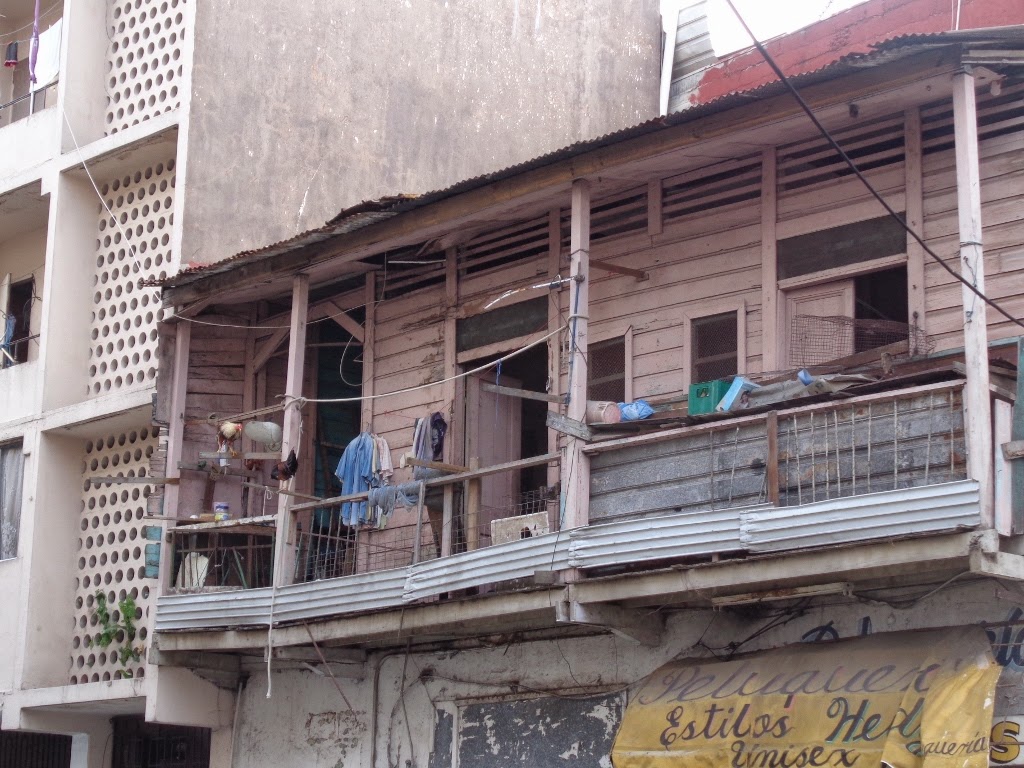
first had to walk through a pretty dirty, dingy and poor part of town. Crumbling old buildings, dirty streets, and
uneven sidewalks with massive holes that could break your leg if you
unknowingly stepped into them. And I
stuck out like a sore thumb with my dry fit t-shirt, tan shorts with many
pockets and obviously gringo looking skin.
But no one hassled me and I even received the odd smile back. Soon I stumbled into Casco Viejo and the
change was dramatic, clean streets, refurbished and freshly painted buildings
but still in the old historic style from a hundred and fifty years before, when
the city was abuzz with the construction of the Panama Canal.
Entering the dirty part of town:

If you look carefully you'll see a chicken on the left side of the balcony:
Now into the nice part of the old town:


Do you like my hat?

Looking back at the new part of town:

The bridge in the distance is quite old, spanning the river near the entrance to the canal:

I found the main Independence Square where a museum about
the canal was located. It was
surprisingly only $2 to enter and thankfully so as there were no English
translations on any of the exhibits so after about half an hour I was out of
there. I wandered around the lovely
neighborhood some more before sitting down for a beer in the Bolivar Square. What a beautiful spot for a cerveza.

The Ministry for Foreign Affairs:

The Minister of Foreign Affairs:

Okay, just a nice balcony with plants...but note the mannequin's leg dangling out on the right side:

Here's the border of the nice, on the right, and not so nice on the left:

Back on the bus up to the Albrook Mall I caught a different
one to cruise out to the causeway, a three to four kilometer land bridge
linking up a few islands just southwest of the city. I figured there might be a great view from
out there of the Panama City skyline, and there was, but you couldn’t see it
thanks to this massive temporary white wall that had been erected for some
construction work of another set of lanes.
Oh well, it was still worth the 25 cent bus ride as on the opposite side
of the causeway were thousands of pelicans, more than I’ve ever seen in my
life, that were diving one after another into the water for some lunch.
The pelicans:
The Panama City skyline:

Along the waterfront:

Groovin' to downtown:

A 360 of downtown:
The next morning I was up early as I planned to catch the
Panama Railway train at 7:15am up to Colon, on route to Portobello where I
would be catching a sailboat to Colombia.
The railroad was constructed in the mid-1800s, before the canal, and was
the first transportation link across the isthmus. It actually served as the quickest way to get
from the east coast of the US to the west coast so many gold prospectors took
this route as the California gold rush started.
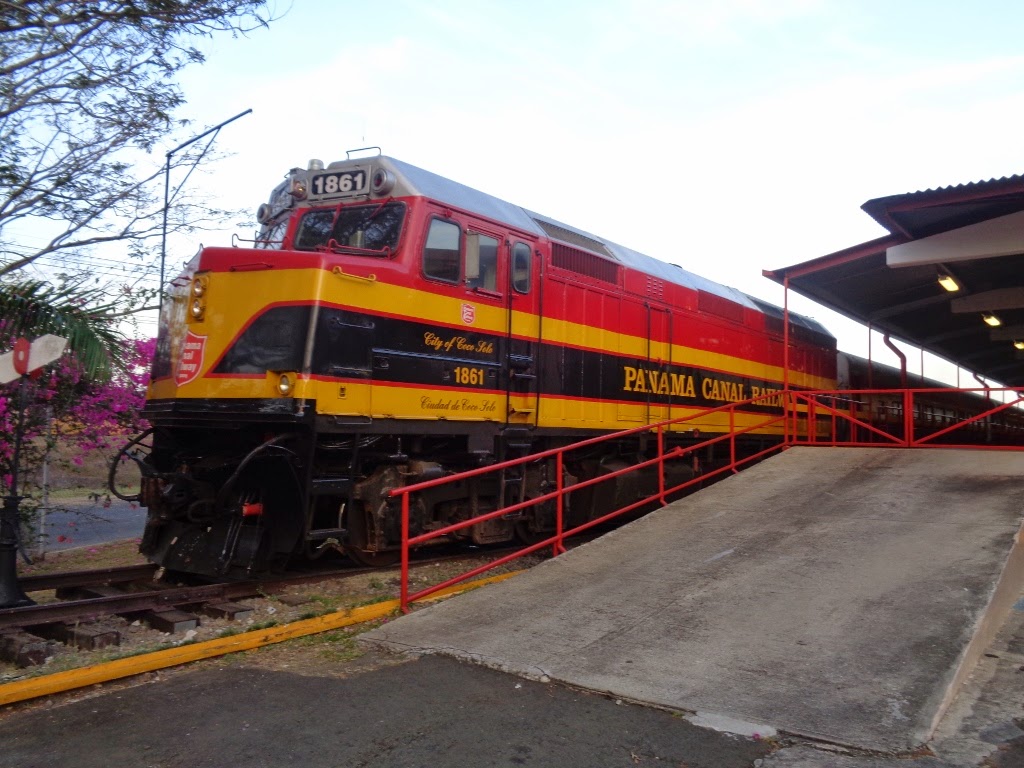
The railcar we (me and about a dozen other tourists…all who were
older than me) rode in was a classic glass domed luxury coach which facilitated
the feeling of following in the footsteps of all those who had ridden this line
in the past, although it also looked like they hadn’t washed the windows since
then. After pulling out of the station
we had a few glimpses of the canal around the Miraflores locks but then it was
mostly jungle until we reached the man made Gatun Lake which serves as a large
part of the waterway.
I felt like it was 1920 again...

So you know Knuffle Bunny...he's on the train with his new friend Flat Stanley. So Knuffle is from my niece Paige's grade 2 class (she's now in grade 6) and another one of my niece's, Brenna, is reading about Flat Stanley and her teacher asked if anyone is travelling somewhere in the world and could take pictures of Stanley in interesting places...so here's his first cameo...

A ship cruising through the canal:

By the lake:
A quiet spot on Gatun Lake:

Enjoying the ride...

About an hour later we were in Colon, once a prosperous
harbour city serving as the gateway to the Pacific, it is now a rundown place
with rampant crime. As an attempt to
inject some life into the city a tax free zone, the second largest in the
world, was set up for distributors of goods.
Before hopping off the train I asked the railcar attendant where the bus
station was as I had read that it was nearby and I planned to head out to the
Gatun Locks. Another couple, Rob and Terry
from Colorado, were asking the same and we decided to share a taxi
together. The awaiting cabbies wanted to
charge us $2 each to get to the bus station which we knew was a rip off but
they tried to impress upon us how dangerous Colon was and that as soon as we
stepped beyond the steel fence a 100 meters away, we were prime targets for
criminals, even though it wasn’t even yet 9am.
We didn’t quite believe their scare tactic and began to walk away when
we were approached by a large black man with excellent English and in a New
York accent he began to charm us into taking us on a tour to the Gatun Locks,
to a secret place where we could view the construction of the new canal
expansion without having to pay the exorbitant $15 entry fee and then return us
to the bus station, all for ten bucks a head.
It sounded good to me but Rob enjoyed haggling with Dino for a while
before we hopped in his big, yet slightly rundown van. Dino was quite the character and he was full
of information, even though the odd fact I didn’t agree with.
Our first stop was in what used to be a US military housing
area up on a hill to give us a view of the construction for the expanded canal
which had been slated to open this year but it looks like it is at least a year
away from completion. Next Dino took us
to the Gatun Locks which turned out to be better than Miraflores as you could
get right up close to the action. An oil
tanker and a dry material tanker were in the process of passing through the
three stage locks and ironically the dry tanker was called the Right Honourable
Paul E. Martin, after a former Canadian prime minister who wasn’t exactly a
charismatic fellow.

The doors of one of the Gatun locks:

The Paul E. Martin tanker entering the lock:

It was super tight, as this is a "panamax" ship, built just to fit in the canal. It did sound like it scraped the side a bit...

Trains guiding the tanker:
Me and Paul:

Kick ass tub boats:

Dino's tour:
Returning to Colon we passed the train station and carried
on to the bus station, which looked to be only about 800 meters away…what a
joke with those taxi drivers earlier, just paying one dollar for all of us
would have been more than plenty. I bid
adieu to Rob and Terry as they were heading back to the capital while I hopped
on a “Red Diablo” (Panama’s version of the chicken bus) to head to the
“beautiful port”: Portobello.


